Category: Air Navigation Services

  • Artificial Intelligence in Air Navigation: Transforming the Future of Traffic Control and Beyond

    Artificial Intelligence (AI) has emerged as a transformative force, reshaping our interaction with technology. In the realm of air navigation, AI applications are driving remarkable advancements, bolstering operational efficiency, and elevating safety standards. At its core, AI empowers machines to learn from data, aiding humans in their tasks and performing functions that traditionally required human intervention. In aviation, this translates into the development of smarter, more efficient solutions that enhance decision-making and streamline operations management.

    Numerous ongoing projects hold the promise of significant improvements in safety, efficiency, capacity, and sustainability. Some notable initiatives include:

    • AI-Based Weather Prediction:
    • AI-Enabled Tactical FMP Hotspot Prediction and Resolutions
    • Automatic Speech Recognition:
    • Conflict Resolution Advisory:
    • Hotspot Identification and Resolution (Short-Term)

    Since 2019, Ingenav has been actively involved in various projects, including:

    • CORA (Conflict Resolution Advisory): Proposes solutions to detected conflicts that uses big data, machine learning and a scoring module to privilege solutions based on pre-set business objectives.
    • FEED: Highlights early identification of future hotspots and proposes efficient resolutions aligned with business objectives.
    • R4 (Ready for): Provides safe and efficient support in nominal conditions (climbs / descents/ transfers) and augments trajectory prediction algorithms and downlinked intelligence
    • ADA (Anomaly Detector): Supports ATCOs in the detection of anomalies related to flows and individual trajectories. Augments other anomaly detection functionalities (e.g. route or level adherence monitoring) and reduces cognitive workload by providing early warnings for anomalies than humans can provide. The 4 projects above are grouped under the name CHarlie – View the video on YouTube: https://www.youtube.com/watch?v=-J6INUxBgPQ
    • AI-enabled tactical FMP hotspot prediction and resolution (ASTRA): ASTRA aims to bridge the gap between the FMP and the en-route ATCO planner position by developing an AI-based tool which can predict and resolve ATC hotspots earlier than today. The tool will yield benefits in the areas of capacity at ATC unit level, efficiency, safety improvements, “green” business trajectories and more predictable operations. (https://www.sesarju.eu/projects/ASTRA)

    We are committed to be part of advancements that redefine the future of air navigation and to influence it as much as possible in the direction of human machine teaming and human centricity.

    In the dynamic landscape of AI implementation in aviation, where clear regulatory frameworks are still evolving, it becomes paramount to exercise due diligence. At Ingenav, we understand the importance of compliance and the need for meticulous validation processes, including the pursuit of Explainable AI (XAI). We also emphasize the importance of being proactive in adhering to industry standards.

    Our belief at Ingenav is that AI is not here to replace humans but to complement us in a human-machine teaming approach. Together, we can navigate the future of air navigation, combining the best of human expertise with the transformative power of Artificial Intelligence.

    Ingenav expertise extends from creating operational concepts to conducting operational validations, which ensures that AI solutions meet operational expectations. This makes Ingenav uniquely positioned to provide guidelines through this intricate journey.

    References:

    Artificial Intelligence (AI) has emerged as a transformative force, reshaping our interaction with technology. In the realm of air navigation, AI applications are driving remarkable advancements, bolstering operational efficiency, and elevating safety standards. At its core, AI empowers machines to learn from data, aiding humans in their tasks and performing functions that traditionally required human…
  • The 1st 100 years of ATC training and the next 10.

    A couple of months ago I was invited to write an article for the IFATCA Controller magazine about the 1st 100 years of training. Here is the text of that article:

    Looking back at the past 100 years, it is astonishing to see how fast the aviation industry developed. In doing so, a need was created to ensure order and safety in flight, and at airports. Air Traffic Control developed in order to meet the demands of safety standards of the young aviation industry.
    The pioneers of this new air traffic control discipline learned from experience. They developed best practices which were gradually turned into rules, procedures and regulations, initially at aerodromes but gradually expanding as aircraft extended their range.

    These pioneering air traffic control experts not only wrote the rules they had adopted: they also began to hand down their knowledge and skills to new generations of controllers. In doing so, they became the first instructors. They held the body of knowledge that bidding air traffic controllers needed before they could move on to practice on-the-job, under the supervision of an established controller: principles of flight, navigation, communication, air traffic procedures. As air traffic grew in volume and complexity, so did the air traffic control system, though almost always slightly lagging behind. As the system matured, so did the realisation that an air traffic controller needed particular skills. Until then, the main criterium for eligibility as a controller was intellect: one needed to have an appropriate educational background. With the realisation that particular skills were also needed, came a new challenge for training: how do we train those skills to the adequate level?

    The answer was through simulation that could expose new controllers to situations that they would possibly experience one day, but that were far from guaranteed to happen during on-the-job training. It made controller    training more efficient and neutralised the higher exigencies borne from the fact that air traffic was becoming so complex that in certain units the on-thejob training, without of the use of prior simulation was becoming very long.

    Over the years, these simulators became increasingly sophisticated. Tower simulators were initially little else than model airports with various ways of moving model aircraft around. More recently, they have benefitted of powerful 3d graphics generation and projection possibilities that can reproduce the most challenging tower situations.

    When I joined ATC in 1995, I discovered a particularly mature system in which the body of knowledge, divided into subjects (what all of us mostly know) was taught first, followed by simulation on generic situations, followed by transitional training from the generic to unit specific and finally to on-the-job training. Almost 30 years have passed since then, and ATC training continued to evolve, growing increasingly sophisticated. Apart from initial training to qualify as a controller, there was an increased need to establish requirements for maintaining the competence and to periodically refresh skills and knowledge. Development training, first for instructors, then for assessors and for other functions developed. Regulation also became with time more sophisticated, and more dominant, with minimum requirements for training to achieve competence, to maintain competence, to train others and to assess competence.

    With the continuous development of the science of human performance and growing understanding of its link to safety, training in applied human factors (notably team resources management) passed from being a best practice to (at least in Europe) a regulatory requirement. Teach and instruct has grown to include facilitate and to coach. None of these four “teaching” techniques can be singled out, as they complement each other and should be used as needed. Students are actively encouraged, most of the time not only to “just” learn but also to reach their best performance and potential. Controllers who act as instructors and assessors are better supported. Maintaining and monitoring competence in day-to-day operations have gotten a lot more focus over the past decades. Air traffic control training has definitely matured in these first 100 years!

    But there are still areas where we can improve. Unfortunately, with explicit regulation becoming very prominent, we tend to forget best practices and good intentions. Performance is measured against regulatory requirements, often ignoring common sense. In some cases, there is even a trend towards mediocrity and doing the minimum possible, rather than seeking excellence. In more extreme cases, it has created a race to the bottom, even if we do not know where that would be. Our regulations far from perfect. They dictate things from a common agreed minimum and, in many cases, there is the unfortunate assumption that compliance with a regulation is a guarantee to obtain the desired outcome. Organisations feel compelled to comply with regulatory requirements, while looking for the cheapest solutions. They are at risk of unlearning essential skills that brought us to where we are and instead. Instead, we explore the lower limits of where training can be rather than to aspire to explore the upper ones.

    So where do I think we will go in the next 10 years? The pessimist in me says that we could keep exploring the race to the bottom until we are confronted with or exposed to serious threats to our safety records. It will then take significant cost and effort to fix the system that we have dismantled. But the optimist in me says that we have always shown professionalism and that we are part of an industry that has always been concerned, at times to the limits of a healthy obsession, with excellence and safety. If we go this way, I can see us progress in three main areas:

    1. We continue in our increased understanding of performance and to advance in our teaching techniques to help student controllers and also our qualified colleagues to reach and maintain the level of competence needed.
      This will pass through the further professionalisation of our instructors, both on-the-job and especially in our schools where we will continue to improve our learning to master a broad number of techniques and skills including coaching, skills training, the understanding of the human factor, the human – automation interface and so forth.
    2. The continuous improvement of technology that needs to accompany our understanding of how performance is acquired and maintained. That we understand which are the fundamental skills of tomorrow´s controller and have the support, through for example sophisticated modules and simulators, to train them and build on them in a seamless way from the beginning through the achievement and maintenance of competency. To better blend skill
      with knowledge acquisition rather than seeing them as two distinct parts.
    3. The third is the training of how we as controllers and our students learn to reflect on our performance, how we learn how to analyse our strong and weak points periodically and frequently stop from the action – reaction duo and include the reflection and make it a threesome (a bit like the famous first de-briefing question we all teach in the OJTI course: “How do you think you did today, Max?”). We can then grow into self-directed learners of our own profession, diagnosing our needs and asking for help as we find necessary.

    In this way, I believe we can move into full maturity for the next 10 and perhaps 100 years, so that human- centricity in our sector takes its full meaning: that we are not only used because there is no other way without us but that we are the conscious part of an increasingly automated system.

  • Let’s talk about capacity

    How many aircraft a runway or an ATC can handle per hour or per any amount of time is a key piece of information that every ATC and ANSP should know.

    Capacity has its own chapter in ICAO doc 4444 where it says “The number of aircraft provided with an ATC service shall not exceed that which can be safely handled by the ATC unit concerned under the prevailing circumstances. In order to define the maximum number of flights which can be safely accommodated, the appropriate ATS authority should assess and declare the ATC capacity for control areas, for control sectors within a control area and for aerodromes.”

    This of course makes a lot of sense and sounds very easy that an ATC service shall handle only the amount of traffic that can safety handle. But how is this number obtained?

    Different states and ANSP have different ways of calculating and expressing capacity, but they all share some same principles.

    Variables

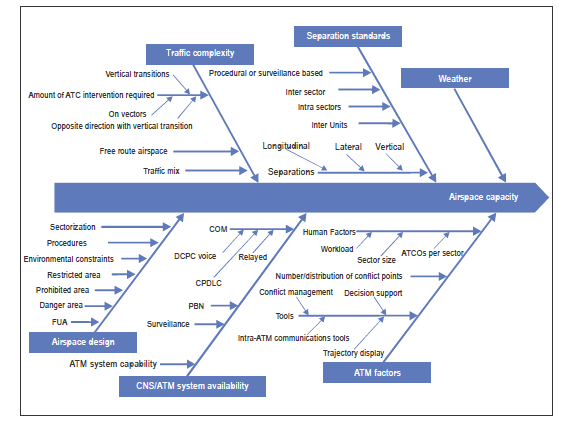
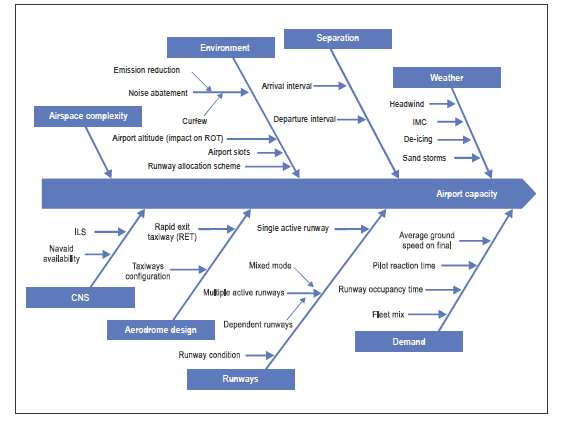
    They all recognize that there are at least, some group of variables that will affect the Runway or Sector Capacity and these are shown in ICAO DOC 9971:

    Capacity output

    Once the variables have been qualitatively identified, it is time to transform them into qualitative values… but what is our desired output?

    Skybrary speaks about three main methods to describe a sector’s capacity:

    • Entry counts: Capacity is expressed in maximum aircraft that are handled per time unit, usually one hour (e.g. 30acft/hour)
    • Frequency occupancy: Capacity is expressed in maximum number of aircraft on the frequency (e.g. 20 acft at the same time)
    • Controller workload: This method is based on an assessment of how much time the controller needs to perform all necessary tasks.

     Which one is the best? There is no single right answer; that will depend on what one is looking for and the operational context.

    Capacity Calculation

    Once we know the variables and our desired output, we can perform our capacity calculation.

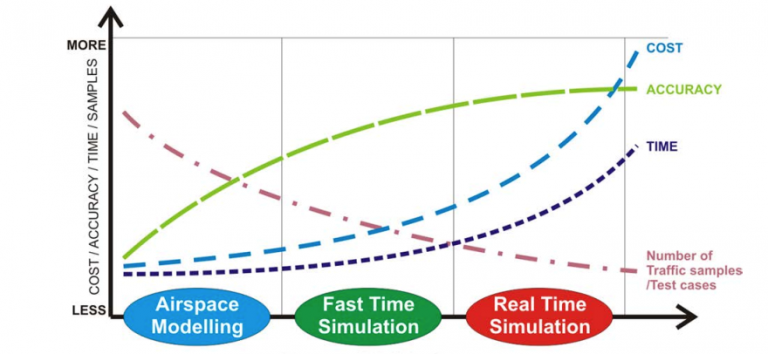
    Again there are several methodologies to perform capacity calculations, where some are based on recollection of data on the operation such as sector flight times, frequency times, etc., others are based on running fast time simulations and others in using simplified methods for faster results.

    An analogy could be made with the validation process for a new airspace:

    Next Steps

    I have calculated my capacity! What now?

    Having calculated your capacity is only the first step. It is important to keep in mind the number and the variables as it is not a fixed value and it might change during the operation.

    There are several actions that can be performed once capacity has been calculated, but probably the most common one is to compare it against the predicted demand and, if it is detected that demand will be greater than the capacity, take some actions to further increase the capacity or to regulate the demand.

    Of course, there are many other actions and assessments that can be performed, but for sure having this value is required.

    INGENAV

    At INGENAV we can help you with:

    • Runway and ATC Sector Capacity Assessments
    • Runway and ATC Sector Training
    • Runway and ATC Capacity Consultancy

    Moreover, INGENAV is certified in ISO 9001:2015 for Design and Delivery of Training in Air Navigation and  Consulting in Air Navigation as well as is a Training Organization for Air Traffic Control training in accordance with EU regulation 340-2015.

  • The importance of Quality for Air Navigation Service Providers

    “My service has the best quality”, “We offer the best quality service to our customers”, “Our service is guaranteed by quality”. Have you ever heard that? Most probably you have. Quality is a word that we hear in everyday and in relation to many different fields, from buying a new TV, hiring a new internet provider, or even playing sports.

    What about the Air Navigation Industry? Quality of service has been a subject for several years now and perhaps more related with Aeronautical Information Management (AIM), Safety Management Systems (SMS) and Flight Procedures Design (FPD), not to mention Service Level Agreements (SLA), but is that all?

    Let’s develop a little further:

    What is Quality?

    Even though there are many definitions for Quality, a good starting point would be ISO’s definition:

    “Degree to which a set of inherent characteristics of an object fulfils requirements.”

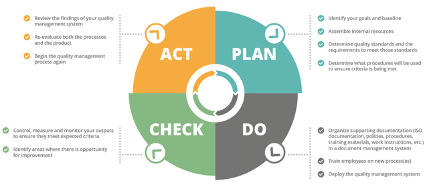
    This means that quality depends on the requirements of what is intended to be done (Good or Service) and how we achieve these requirements. This simple sentence implies a lot, and it brings the possibility to plan, do, check, act, and plan again to fulfil our goal.

    Process in Quality

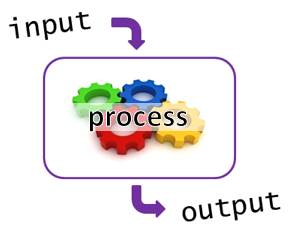
    Basically, a process are series of actions or steps taken to achieve a particular end.

    In this way of thinking there are 3 basic phases:

    • Input: Where the goods, data, service or whatever we need to produce are collected
    • Process: Where the input is transformed into something new
    • Output: Where the final product is presented

    Let’s explore examples of this in Air Navigation Services:

    • Aerodrome data is surveyed by using its own process. The data collected (output).
    • This output will be an input for AIS/AIM where a new AIP will be made.
    • The new AIP will be a new input for Flight Procedure Designers which will produce as an output a new Procedures and Charts.
    • This Procedures and Charts will be loaded into Aircraft’s FMS and ANSP’s ATM Systems.

    This chain of inputs and outputs looks perfect in theory but what would happen if one piece of data Aerodrome data surveyed had a mistake and was not detected?

    Garbage In Garbage Out

    There is a concept mainly used in IT which states that the quality of the input determines the quality of the output. In other words, the quality coming out is dependent on the quality of the input.

    The importance of this concept remains in that what we do in Air Navigation Services has direct impact on the Safety of the Operations.

    Keeping Operations Safe

    There are many documents from different organizations about how safety is achieved, but they all agree on that Quality is required for a Safety Management System to work properly.

    One of the most famous models used in safety is James Reason’s Swiss Cheese model.

    In the Swiss Cheese model, an organisation’s defences against failure are modelled as a series of barriers, represented as slices of the cheese.

    The holes in the cheese slices represent individual weaknesses in individual parts of the system and are continually varying in size and position in all slices.

    The system produces failures when holes in all of the slices momentarily align, permitting “a trajectory of accident opportunity”, so that a hazard passes through holes in all of the defences, leading to an accident.

    Usually, an organisation’s defences can be described in 3 categories:

    • Technology
    • Procedures
    • Human Competence

    This defences work as an input for the safety process, therefor it is fundamental to have an excellent quality on them.

    How can an ANSP make sure that their input for safety will have the required quality

    There are 2 basic ways:

    • If Technology, Competence acquisition (training) or Procedures are contracted from another provider, make sure that the provider has at least an ISO 9001 certification and not only a “generic” specification but with a specific mention in the required process.
    • If Technology, Training or Procedures will be performed in house, have these process certified.

    INGENAV and Quality Certification

    Ingenav has been certified in ISO 9001:2015 for its quality management system since 2016, and not just certified in a general way, but specifically in:

    • Design and Delivery of Training in Air Navigation
    • Consulting in Air Navigation

    This means that what INGENAV does, regarding Training and Consultancy, has Certified Quality and will fulfil the customer’s requirements.

    Moreover Ingenav has also been certified since 2018 as a Training Organisation for Air Traffic Control training in accordance with EU regulation 340-2015.

  • Air Navigation Services ORAT: Operational Readiness and Transition

    What is an ORAT?

    Changes bring opportunities but they also bring risks. In safety and time critical environments, these risks, if unmanaged, can have very serious consequences.

    Operational Readiness and Transition (ORAT) is a methodology that provides a framework for managing the risk that changes bring with it, be it due to changes in facilities, configuration or procedures. This methodology also aims at harnessing the opportunities that the same changes bring. ORAT is a methodology highly used in changes affecting airport operations. It can equally be applied to other changes in the aviation industry such as those affecting Air Navigation Services.

    A typical project focus is on construction delivery and completion of a static asset (cost, time and quality), operational readiness is focused on the dynamic state of a business operation, integrating all of the diverse moving parts into one, cohesive, dynamic operation.

    An ORAT is used mainly because it:

    • Ensures smooth start / transition of operations.

    • Provides controlled and managed planning, preparation and execution of operational readiness processes.

    • Integrates all stakeholders (air navigation services (management and staff), airport operations, regulation and certification, airlines, handling, etc.) 

    • Ensures buy-in and safe and efficient process

    ORAT Components

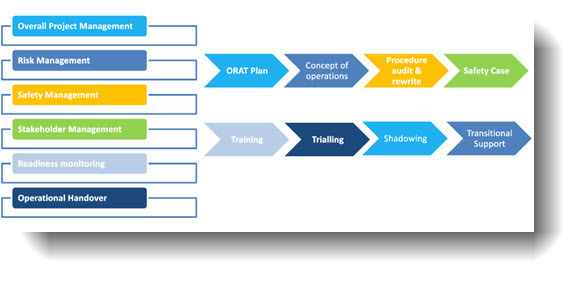
    Every project is different; however usually an ORAT will have the following elements:

    ORAT Components

    It is important to remark that each of these elements has a purpose in the ORAT process and it should be properly handled.

    Also, an ORAT will require excellent coordination between Operational, Technical and Safety/Regulatory parties.

    Human Centric Approach

    We believe that the best way of doing an ORAT is keeping in mind that Humans are always a key part, as we are the ones who are involved in every operation.

    The various ORAT sub-phases such as Concept, Procedures, Safety, Training, Shadowing have also the objective of permitting the main actors (e.g. Management, Operations, Engineering, Safety Management, Regulatory Oversight, etc.) to gain confidence in the system, therefore, increasing the acceptance of the system as a whole and increasing the chances of a successful transfer of knowledge.

    ORATs aim not only to prepare everything for operations but also to transfer essential knowledge on procedures, training and safety management as well as transition management to the staff during the process.

    INGENAV we are confident that when a big change will happen, an ORAT is a key element for a successful transition into the new operation environment.

    We base this on our knowledge and in our experience of previous projects where with the use of ORAT, successful implementations have taken place.