Changes bring opportunities but they also bring risks. In safety and time critical environments, these risks, if unmanaged, can have very serious consequences.
Operational Readiness and Transition (ORAT) is a methodology that provides a framework for managing the risk that changes bring with it, be it due to changes in facilities, configuration or procedures. This methodology also aims at harnessing the opportunities that the same changes bring. ORAT is a methodology highly used in changes affecting airport operations. It can equally be applied to other changes in the aviation industry such as those affecting Air Navigation Services.
A typical project focus is on construction delivery and completion of a static asset (cost, time and quality), operational readiness is focused on the dynamic state of a business operation, integrating all of the diverse moving parts into one, cohesive, dynamic operation.
An ORAT is used mainly because it:
• Ensures smooth start / transition of operations.
• Provides controlled and managed planning, preparation and execution of operational readiness processes.
• Integrates all stakeholders (air navigation services (management and staff), airport operations, regulation and certification, airlines, handling, etc.)
• Ensures buy-in and safe and efficient process
ORAT Components
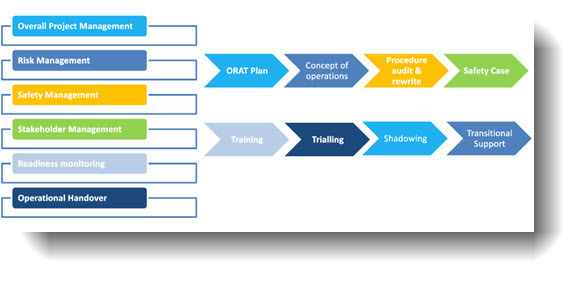
Every project is different; however usually an ORAT will have the following elements:
ORAT Components
It is important to remark that each of these elements has a purpose in the ORAT process and it should be properly handled.
Also, an ORAT will require excellent coordination between Operational, Technical and Safety/Regulatory parties.
Human Centric Approach
We believe that the best way of doing an ORAT is keeping in mind that Humans are always a key part, as we are the ones who are involved in every operation.
The various ORAT sub-phases such as Concept, Procedures, Safety, Training, Shadowing have also the objective of permitting the main actors (e.g. Management, Operations, Engineering, Safety Management, Regulatory Oversight, etc.) to gain confidence in the system, therefore, increasing the acceptance of the system as a whole and increasing the chances of a successful transfer of knowledge.
ORATs aim not only to prepare everything for operations but also to transfer essential knowledge on procedures, training and safety management as well as transition management to the staff during the process.
INGENAV we are confident that when a big change will happen, an ORAT is a key element for a successful transition into the new operation environment.
We base this on our knowledge and in our experience of previous projects where with the use of ORAT, successful implementations have taken place.
The no-prize answer is ‘because we have to’. The correct one is because we cannot afford not to.
ICAO Annex 13 lays out the consolation that ‘the sole objective of the investigation of an […] incident shall be the prevention of […] incidents. It is not the purpose of this activity to apportion blame or liability’. The tangible outcome of an incident investigation is the Investigation Report housing sections on Factual Information, Analysis, and Conclusions. It only stands to reason that Factual Information has to be obtained and suitably analysed for conclusions be drawn as to WHAT actually happened, and WHY it happened. Now comes the sticky part, for the Investigator is also tasked with coming up with Safety Recommendations. I admit that, as an Incident Investigator, I have often slept uneasy over this last responsibility. I have gathered and examined written and verbal reports, I have listened to voice recordings and transcribed them, I have watched the video recordings of the occurrence or the radar screen as well as the relative keyboard inputs, I have interviewed all involved and obtained as much information as to what was happening. I have made myself familiar with all the circumstances at the time. Armed with all available data, I have absolutely no problem with reaching conclusions about causal and contributing factors. On these I am now an authority. But to make recommendations? I look back to the courses I attended, and the training seminars I endured (and lately made others endure), and note with disappointment that this ultimate ‘must do’ has, all-too-often, been very much glossed over. We make it sound as if coming up with recommendations is simply a natural follow-up to all the digging made, and these will simply fall into the lap of the deserving. The bad news is that this is far from it.
I can put suggestions on how to right obvious shortcomings; I can also extrapolate the actual happening to include ‘what if’ scenarios and decide if the available procedures or resources carry enough resiliency. But I have, at times, felt insufficiently equipped to confidently reassure myself that I have covered all possible recommendations. Is it enough to point out that inappropriate phraseology was a contributing factor to a runway incursion? Or, that better employment of speed control could have averted an unwholesome situation? Or, that letters of agreement between sectors do not cover all eventualities? I question myself, should I spell out a recommendation that personnel attend mandatory phraseology or speed control refresher training? Or oblige the powers that be to revisit procedures? What if I overlook a recommendation which could avert another incident in the future? Should I conscientiously take responsibility for my recommendations to not adversely impact my company financially? Should I even be questioning myself about such? Uneasy is the head that wears the headset marked Incident Investigator.
Making recommendations is an onerous responsibility. A medical doctor, having examined the patient and carried out the required tests, writes out the appropriate chemicals to be ingested to right the ailment. The Investigator prescribes appropriate remedial attention to avert a repetition of an unpleasant happening. The patient implicitly puts his trust in the good doctor and happily downs pink capsules before meals; the system trusts the recommendations to be the best cure to a malady. The recommendations being delivered, the ANSP decides if they should be implemented: whether in their entirety or in part, the method and the timing. The Investigator’s report is only testament to her findings coupled with her experience; it is the ANSP’s call to implement the corrections. The entity is answerable to its clients, its professionals, and the overseeing Authority.
Approaching summer of 2020, we are in a shell-shocked state. We do not know what the postdiluvian world will look like. Regarding Investigator training, we have, in recent years, witnessed the progressive reduction of the instruction and practice period. One can only assume these will be decreased even further. e-TOKAI* has wonderfully enabled the reporting and investigation process to be conveniently wrapped up in a seamless package with a deliverable document rolling out at the other end. The Tool has taken out the hassle and intricacies of building a report while ensuring that all possible data is collected. Investigation reports have become more standardised, coherent and thorough. e-TOKAI sees to that. Sadly, the free-text areas can be more disappointing. Investigator training, even more limited as it might evolve, will continue to train candidates in data gathering, interviewing techniques and gaining personnel trust, but more consideration should be given to the quality of report writing.
Writing reports is an art form. The writer has to keep the intended consumer in mind. The report culminates in the Recommendations area, and the Investigator has to ‘sell’ her recommendations in the most convincing manner. A badly structured report will not inspire a sale, and a badly written one will only alienate its audience, rendering the exercise futile.
At the end of a report come the recommendations. Mine is to revisit the Investigator training material, give e-TOKAI its room to do what it does best, and better employ time and resources to train our professionals to construct better reports and put forward meaningful recommendations.
We cannot afford otherwise.
* e-TOKAI is Eurocontrol´s toolkit for air traffic management occurrence investigation.
Renald Galea is an Air Traffic Controller with vast experience as an Incident Investigator and the use of e-TOKAI and RAT.
There should be little doubt or argument that the journey towards further automation in Air Traffic Control is well on its way and is set to continue. Also, there is little doubt that many of the future solutions will have, at least, some of their components based on Artificial Intelligence techniques.
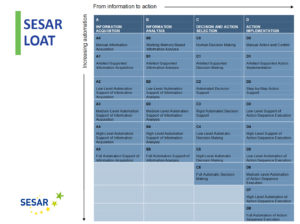
If we look at SESAR´s Level of Automation Taxonomy (LOAT) model as displayed below,
most modern ATC Systems are somewhere between B4/B5: High level – full automation support of information analysis and C1: Artefact-supported Decision Making.
The end goal for most R&D projects is to arrive to D8: Full automation of action sequence execution for all ATC tasks.
This raises a few items to consider and this is what we at Ingenav think about this:
Until D8 is reached on all ATC tasks (whether it will be desirable for it to be reached is the subject of item 2), humans will be part of the system and the system will need to be Human-Centric.
It is questionable whether, even if technologically possible, it would be desirable to reach D8 and have a non-human-in-the-system ATC chain.
Developing these items, a little further we need to consider:
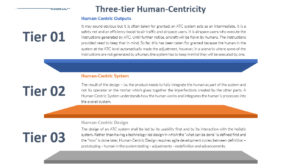
A three-tier Human-Centric approach is necessary:
Human-Centricity needs to be seen holistically:
The design of an ATC system needs to be done through a human-centric approach. The result, i.e. the ATC system itself needs to be human-centric. And with the growing autonomy coming about, one shall not forget that the end-user of ATC is not the air traffic controller but the airspace user: the human who flies the aircraft. These are the three tiers – from the design, to the product itself, to its output.
Starting from Tier 3: Human-Centric design:
The design of an ATC system shall be led by its usability and by its interaction with the holistic system first. Rather than having a technology-led design in which the “what can be done” is defined first and the “how” is done later, human-centric design requires agile development cycles between definition – prototyping – human in the system testing – adjustments – redefinition and advancements. The design team needs to incorporate from a very early stage operational expertise that understands the business and the process and that co-lead the design. This should be the case even when the functionalities that are being developed would be in the high Ds in accordance with LOAT as these will always interact with other processes where the human is involved.
Tier 2: Human-Centric system:
The result of the design – i.e. the product, needs to fully integrate the human as part of the system and not its operator or the mortar which glues together the imperfections created by the other parts. A Human-Centric system understands how the human works and integrates the human´s processes into the overall system. Principles such as relevance, timeliness, prioritized and rationalized for human understanding should be key in all the interactions of a human-centric system.
Tier 1: Human-Centric outputs:
It may sound obvious but it is often taken for granted: an ATC system acts as an intermediate; it is a safety net and an efficiency boost to air traffic and airspace users (that is the objective of ATC!). It is airspace users who execute the instructions generated by ATC. Until further notice, aircraft will be flown by humans. The instructions provided by ATC need to keep that in mind. So far, this has been taken for granted because the human-in-the-system at the ATC level automatically made the adjustment. However, in a scenario where some of the instructions are not generated by a human, the system has to keep in mind they will be executed by one.
It is important to insist on Human-Centricity and the human-in-the-system principle and not to see the human as an external agent who acts as an operator or a mediator, or even worse as a corrector of imperfections. It is important to take the learnings we have made in the past decades and build on them rather than to try to discard them because we believe that advanced automation will make the human somehow less important.
Question 2: is it desirable to arrive to D8?
The quick answer to this is that we don´t know. To date, we do not have the maturity to understand what a fully autonomous system, which in turn is an intermediate between vigilance and execution, would mean. The gap to get there is still too big and we need to narrow this gap in order to understand better the ramifications. Of the ramifications, we are able to identify to date one can include resilience, of such a system and degraded modes, interconnectiblity, responsibility, certification, the holistic concept of operations of the airspace user and societal (is it, in fact, desirable and productive from a societal perspective to try to eliminate the human from the system?).
R&D in this area must continue and needs to be holistic and not just technology-driven. We can do a lot of things but should we apply them? By continuing R&D, the sector will mature further and whilst bridging the gap, we will also understand the opportunities and the threats that such changes would bring. If we ever reach D8, it should be an evolution and not a revolution.
Conclusion
Undoubtedly, work is in progress towards advanced automation in the lines of decision-making support and basic autonomous execution of tasks. Human-Centricity is primordial in the development of such tools and this human-centricity needs to be taken care of in 3-tiers: at design, at the system and at output levels. Achieving D8: full automation of task execution for all tasks making up ATC should be an R&D goal and not an operational one at this stage. The gap between the current paradigm and that one is too wide and we do not have the maturity to understand the ramifications of such a change. R&D needs to be holistic and not just technology-driven. A stepwise approach towards understanding will be necessary.
PS, Ingenav is currently participating in a project with a Core European ANSP and ATC system manufacturer to introduce Decision Support Operational ATC tools using amongst other historical data and machine learning principles. In this project, a 3-tier Human-Centric approach is being applied.
Airport Collaborative Decision Making course
Airport CDM covers the processes and eventual tools that permit airport partners to work together more efficiently and transparently.
This three day course emphasises the benefits to all airport partners through highlighting the importance of full and common operational situational awareness. It explains how to fully implement Airport CDM at the delegates’ respective airports and describes the local benefits, the return on investment and the gains envisaged for the overall ATM network.
Delegates will receive a detailed understanding of data sharing and situational awareness at airports between all players involved and gain an understanding of the difficulties that may be encountered, plus how to successfully secure support from colleagues.
Introduction to Air Traffic Flow Control Management (ATFCM) course
This three day course provides a good theoretical knowledge and understanding of Air Traffic Flow and Capacity Management and Network Operations, mainly focusing on the operational processes of the Aircraft Operators.
The course covers principles of flow control, flight planning, IFPS, Network operations portal, and the Network Manager’s systems and procedures.
CRM is the effective use of all available resources for flight crew personnel to assure a safe and efficient operation, reducing error, avoiding stress and increasing efficiency.
The objective of the three day CRM course is to provide candidates with the knowledge, training and skills in interpersonal areas to improve aircrew safety and efficiency.
This two day course covers the phenomenon of fatigue and its effects on safety, performance and health in ATM.
Candidates will learn to understand what causes fatigue and also look at sleep science and how it can help in developing strategies for the prevention and management of fatigue.
The course also examines the relationship between the regulations EU 373-2017 and EU 340-2015 and Fatigue.
This two day course covers understanding the causes of stress, how stress affects individuals, constructing strategies for its prevention and how to manage it. All necessary skills for both ATM Management and Operational Staff.
The course also covers the relationship between regulations EU 373-2017 and EU 340-2015 and Stress.
This three day course focuses on those facets that facilitate an increase of safety and efficiency in an operational environment via the effective use of the different components forming an operational aviation team.
The TRM course is an acceptable means of compliance with ATC Refresher Training in Human Factors.
This five day course facilitates learning through discussion, presentations and group work on improving management practices for operational supervisors, by raising awareness in the personal, team, organisational and external dimensions and domains.
The course is based upon EUROCONTROL´s Guidelines for Management Training for Operational ATM Supervisors (HRS/TSP-004-GUI-07).
This is a two day course giving candidates a comprehensive introduction to human factors in aviation, as well as showcasing the key reference documents and examining methodologies.
The course covers, the origins of human factors, a systemic approach to human factors, the human information processing model, human error, decision making, situational awareness, stress management and more.
Effective Interpersonal Communication Skills course
During this course candidates will improve their understanding of cross-cultural differences, explore different communication methods, and learn how to deliver information clearly and concisely according to the needs of an audience, particularly in an operational environment.
This course also teaches about the following types of communication: verbal and non-verbal, written, briefings, and refines presentation skills, forming communications plans, etc.
This three day course delves into how to perform a training needs analysis, covering topics such as identifying the skill/knowledge gap, who are the target audience, the difference between skills and knowledge requirements, setting training objectives, and more.
There are two Synthetic Training Device Instructor (STDI) courses in the training programme, an initial and refresher course.
Both courses cover the theoretical knowledge and practical skills for controllers who will undertake instructional duties on a simulator or a synthetic training device.
This two day course introduces the specific elements of management in a training function and includes: training strategy, human resources, facilities, communication, training portfolio, among others.
It enables participants to understand the key elements of managing training in small and large organisations and to bring the training function into the strategic core of an organisation.
This is a five day course course covering various techniques on how to deliver classroom instruction. It includes: lecturing, facilitation, presentation skills, establishing contact with students, motivation, obtaining feedback and more.
Upon completing this course, candidates will have the ability to prepare effectively for training, managing and evaluating training events, to teach students with improved skill, have practical presentation and communication skills and be able to motivate participants and engage their participation during training.
This four day course explores the training development process from the moment the syllabus and objectives have been determined, right up until the course is ready for delivery.
It includes identifying and describing the different phases of the instructional design process; converting training needs into performance objectives; identifying characteristics that influence the design and delivery of a training course, creating lesson plans, choosing training media and methods, and developing training material and assessments. It also includes how to evaluate training success.
Max began his Air Traffic Control career at the EUROCONTROL Maastricht Upper Area Control Centre (MUAC) in 1995, where he remained until 2010. During that time he occupied various positions in operations, training, and business management.
Max left EUROCONTROL to join SENASA as Head of Training in Madrid, Spain and is now Ingenav’s CEO, carrying out projects concerning air navigation Operations, safety assessments, human factors and training.
Unusual situations, emergencies and contingencies course
This three day course is custom made for the rating being trained on, i.e. Tower, Approach or En-Route and is based on practicing different scenarios using an ATC Simulator.
It explores several unusual or emergency situations and shows the commonalities between them.
The aim of the course is to present unusual and emergency situations, and to practice and refresh procedures on how to best manage them.
Introduction to Communication, Navigation and Surveillance
This two day course on Communications, Navigation and Surveillance systems in Air Traffic Management aims to give a good overview of the systems, what they are, how they interact with one another and how together they enable current and future air traffic services.
The course also discusses how these systems will likely develop in the future, including the elements and enablers that will make the system work, and the implementation strategies.
This two day course aims to give a good overview of how the air traffic management part of aviation is organised (air traffic services, airspace management, flow control, etc.)
This course provides participants with an overview of how current air traffic is managed as well as how this will probably develop in the future, including the elements and enablers that will make the system work and the strategy for its implementation.
It outlines the organisation of airspace, the time sequence for flow management and flight events, and the data flow and interactions between databases and controller working positions including the dialogues between pilots and air traffic controllers.
Rachael is a safety psychologist with more than 25 years’ experience in human factors and safety culture in the aviation and energy sectors.
After completing her PhD at Aberdeen University, in human factors incident investigation systems in the oil and gas industry, Rachael became a Human Factors Expert in air traffic management at EUROCONTROL.
She has undertaken safety culture surveys across European Air Navigation Service Providers, as well as at a regional airline in Kenya. She is currently involved in human factors assessments of new systems in ATM and is developing training on Stress and Fatigue Management as a freelance consultant.
Nicolas has over 10 years of experience in Aviation and Air Navigation Services, beginning his career as an Air Traffic Controller in Ezeiza Tower, Argentina. He later responsible for the planning department in Empresa Argentina de Navegacion Aerea (EANA) and subsequently its planning manager.
Nicolas has been involved in diverse aviation projects including airspace redesigns, new service implementations, and ATC sector and runway capacity changes.
Nicolas holds a CPL/IR and is Ingenav’s training manager and Senior ATM Consultant.
Mike is an Aviation Safety Expert with over 40 years of experience.
He is member of the International Society of Air Safety Investigators (ISASI) and of the Canadian Owners and Pilots Association and has served as a member for Civil Air Search and Rescue for more than 25 years.
Currently, Mike develops and provides safety awareness training and guidance on Implementation of Risk Management programs and Safety Management Systems, Crew Resource Management, Pilot Decision Making, Human Performance in Aircraft Maintenance, Human Factors in ATC Operations, Company Aviation Safety Officer and Human Factors in Airport Operations.
Araceli graduated in Labour Relations and has over 20 years’ experience in business management.
Prior to joining Ingenav, Araceli worked as a Human Resources Director and an Administration and Finance Director across several different sectors, in both public and private companies.
Araceli is Ingenav’s Quality, Safety and Administration Manager where her main responsibilities include ensuring the company meets its safety and quality commitments, and the effective management of all the company’s administrative processes.
Carlos started his career in 2005 as a technical engineer in computer systems, working in command and conquer international programs for several armies.
In 2008 Carlos participated in ATC programs, developing, analysing and testing functions in the SACTA system, mainly in Flight Plan Terminal.
In 2012, Carlos started working in integration and developing helicopter simulators for the Spanish army and, during 2015, he worked on the development of a secure navigation platform.
Carlos has collaborated with Ingenav as software engineer since 2016.
Anthony Seychell is an accomplished ATM safety expert with a background in both ATC operations and ATC engineering.
Previously having held a variety of posts at Malta Air Traffic Services, the most recent being as Safety Manager, Anthony joined EUROCONTROL in 2007 and was coordinator of the Programme supporting ANSPs in SMS Implementation (SASI) and he provided support for other ESP activities until his retirement in 2021.
Anthony remains active in numerous ATM initiatives.
Max began his Air Traffic Control career at the EUROCONTROL Maastricht Upper Area Control Centre (MUAC) in 1995, where he remained until 2010. During that time he occupied various positions in operations, training, and business management.
Max left EUROCONTROL to join SENASA as Head of Training in Madrid, Spain and is now Ingenav’s CEO, carrying out projects concerning air navigation Operations, safety assessments, human factors and training.
David began his career as an Electronics and Communications Engineer, migrating into the then new field of Information Technology and subsequently worked in many different IT areas including Networking, PC Support, Server and Database Administration and Project Administration.
He served as a Civilian Instructor with the Royal Air Force Reserve (Training branch) for six years, where he taught multiple aviation subjects among other things. A qualified PPL(A) and simulator pseudo-pilot who knows the PRINCE 2 and PPS project management methodologies, he is also a CELTA-certified teacher of English as a Second Language specializing in Aviation English.
David joined Ingenav in 2021 as the company’s Technology Manager and Project Admin.
Carlos started his career in 2005 as a technical engineer in computer systems, working in command and conquer international programs for several armies.
In 2008 Carlos participated in ATC programs, developing, analysing and testing functions in the SACTA system, mainly in Flight Plan Terminal.
In 2012, Carlos started working in integration and developing helicopter simulators for the Spanish army and, during 2015, he worked on the development of a secure navigation platform.
Carlos has collaborated with Ingenav as software engineer since 2016.
Anthony Seychell is an accomplished ATM safety expert with a background in both ATC operations and ATC engineering.
Previously having held a variety of posts at Malta Air Traffic Services, the most recent being as Safety Manager, Anthony joined EUROCONTROL in 2007 and was coordinator of the Programme supporting ANSPs in SMS Implementation (SASI) and he provided support for other ESP activities until his retirement in 2021.
Anthony remains active in numerous ATM initiatives.
Rachael is a safety psychologist with more than 25 years’ experience in human factors and safety culture in the aviation and energy sectors.
After completing her PhD at Aberdeen University, in human factors incident investigation systems in the oil and gas industry, Rachael became a Human Factors Expert in air traffic management at EUROCONTROL.
She has undertaken safety culture surveys across European Air Navigation Service Providers, as well as at a regional airline in Kenya. She is currently involved in human factors assessments of new systems in ATM and is developing training on Stress and Fatigue Management as a freelance consultant.
Mike is an Aviation Safety Expert with over 40 years of experience.
He is member of the International Society of Air Safety Investigators (ISASI) and of the Canadian Owners and Pilots Association and has served as a member for Civil Air Search and Rescue for more than 25 years.
Currently, Mike develops and provides safety awareness training and guidance on Implementation of Risk Management programs and Safety Management Systems, Crew Resource Management, Pilot Decision Making, Human Performance in Aircraft Maintenance, Human Factors in ATC Operations, Company Aviation Safety Officer and Human Factors in Airport Operations.
Nicolas has over 10 years of experience in Aviation and Air Navigation Services, beginning his career as an Air Traffic Controller in Ezeiza Tower, Argentina. He later responsible for the planning department in Empresa Argentina de Navegacion Aerea (EANA) and subsequently its planning manager.
Nicolas has been involved in diverse aviation projects including airspace redesigns, new service implementations, and ATC sector and runway capacity changes.
Nicolas holds a CPL/IR and is Ingenav’s training manager and Senior ATM Consultant.
Araceli graduated in Labour Relations and has over 20 years’ experience in business management.
Prior to joining Ingenav, Araceli worked as a Human Resources Director and an Administration and Finance Director across several different sectors, in both public and private companies.
Araceli is Ingenav’s Quality, Safety and Administration Manager where her main responsibilities include ensuring the company meets its safety and quality commitments, and the effective management of all the company’s administrative processes.
Max began his Air Traffic Control career at the EUROCONTROL Maastricht Upper Area Control Centre (MUAC) in 1995, where he remained until 2010. During that time he occupied various positions in operations, training, and business management.
Max left EUROCONTROL to join SENASA as Head of Training in Madrid, Spain and is now Ingenav’s CEO, carrying out projects concerning air navigation Operations, safety assessments, human factors and training.
David began his career as an Electronics and Communications Engineer, migrating into the then new field of Information Technology and subsequently worked in many different IT areas including Networking, PC Support, Server and Database Administration and Project Administration.
He served as a Civilian Instructor with the Royal Air Force Reserve (Training branch) for six years, where he taught multiple aviation subjects among other things. A qualified PPL(A) and simulator pseudo-pilot who knows the PRINCE 2 and PPS project management methodologies, he is also a CELTA-certified teacher of English as a Second Language specializing in Aviation English.
David joined Ingenav in 2021 as the company’s Technology Manager and Project Admin.