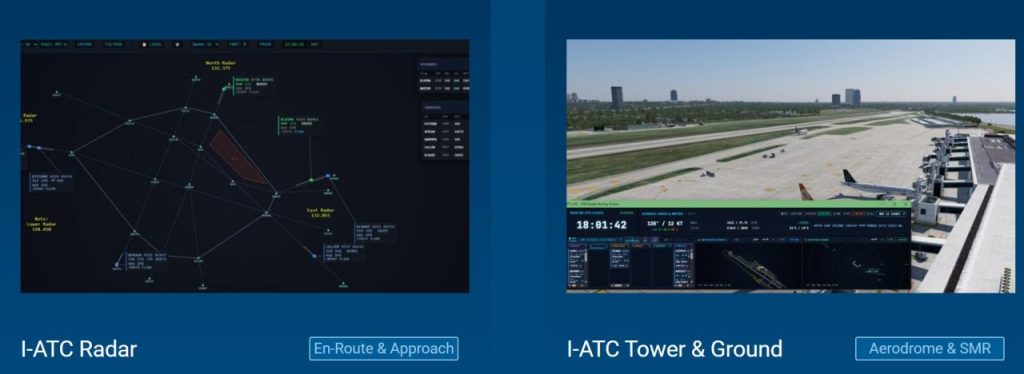
We are very excited to announce I-ATC, the ATC Platform Suite for simulation, training, research and validation that INGENAV has developed following many years of knowledge and insight we have gathered with regards to the use of other third-party products.
I-ATC unifies Ground, Tower, Approach, and En-Route operations into a lightweight, browser-native platform. It has been designed by air traffic controllers and operational experts to deliver realistic aircraft performance and the operational ergonomics of modern ATM systems — eliminating the prohibitive cost and rigidity of legacy architectures.
I-ATC also features our philosophy open by design, connected by choice, allowing users to create their own plugins to modify both backend and frontend with total freedom, enabling endless possibilities.
Designed for:
ANSPs & Operational Units Rapidly validate airspace redesigns, new sectorisations, and operational CONOPS without taking production ATM systems offline or waiting for costly vendor updates.
Training Organisations & ATOs Deliver compliant ab-initio and rating training on demand. Run multiple concurrent exercises with independent simulation clocks, automated recording, and synchronized debriefing replays.
Research Labs & Universities Accelerated innovation testbed for advanced ATM concepts, UAM integration, and AI decision support. Inject and consume 4D telemetry using open Python SDK, WebSockets, and REST APIs.
Some key features:
Zero Proprietary Hardware Runs smoothly in modern web browsers on standard COTS workstations. Eliminates complex room rebuilds, drastically reducing deployment overhead and total cost of ownership.
Visual Airspace and Scenario Editors Build custom sectors, airways, SIDs, STARs, and traffic scenarios in minutes with intuitive graphical editors — zero vendor reliance.
Multi-Exercise Concurrency & Independent Clocks Run multiple concurrent training or validation sessions on a single server, each with fully independent simulation timelines, pause/resume, and time-scale controls.
Advanced 4D FDP & Realism Continuous 4D trajectory prediction, realistic performance envelopes, and integrated safety nets (STCA, MSAW, APW, MTCD, etc) for complete fidelity.
Flexible Deployment & Sovereignty Deploy on your terms: 100% on-premises for maximum data sovereignty, or in private/hybrid cloud for instant distributed access. Zero vendor lock-in.
Instant Replay & Debrief Millisecond-accurate timeline recording with interactive time-slider playback, event logging, and multi-position synchronized debriefing.
Extensible Plugin & API Ecosystem Go beyond out-of-the-box capabilities. Create custom plugins, connect AI models, or integrate external tools with open Python SDK, WebSockets, and REST endpoints
Discover the next generation of ATM Platform or contact us to schedule a live demo
A couple of months ago I was invited to write an article for the IFATCA Controller magazine about the 1st 100 years of training. Here is the text of that article:
Looking back at the past 100 years, it is astonishing to see how fast the aviation industry developed. In doing so, a need was created to ensure order and safety in flight, and at airports. Air Traffic Control developed in order to meet the demands of safety standards of the young aviation industry. The pioneers of this new air traffic control discipline learned from experience. They developed best practices which were gradually turned into rules, procedures and regulations, initially at aerodromes but gradually expanding as aircraft extended their range.
These pioneering air traffic control experts not only wrote the rules they had adopted: they also began to hand down their knowledge and skills to new generations of controllers. In doing so, they became the first instructors. They held the body of knowledge that bidding air traffic controllers needed before they could move on to practice on-the-job, under the supervision of an established controller: principles of flight, navigation, communication, air traffic procedures. As air traffic grew in volume and complexity, so did the air traffic control system, though almost always slightly lagging behind. As the system matured, so did the realisation that an air traffic controller needed particular skills. Until then, the main criterium for eligibility as a controller was intellect: one needed to have an appropriate educational background. With the realisation that particular skills were also needed, came a new challenge for training: how do we train those skills to the adequate level?
The answer was through simulation that could expose new controllers to situations that they would possibly experience one day, but that were far from guaranteed to happen during on-the-job training. It made controller training more efficient and neutralised the higher exigencies borne from the fact that air traffic was becoming so complex that in certain units the on-thejob training, without of the use of prior simulation was becoming very long.
Over the years, these simulators became increasingly sophisticated. Tower simulators were initially little else than model airports with various ways of moving model aircraft around. More recently, they have benefitted of powerful 3d graphics generation and projection possibilities that can reproduce the most challenging tower situations.
When I joined ATC in 1995, I discovered a particularly mature system in which the body of knowledge, divided into subjects (what all of us mostly know) was taught first, followed by simulation on generic situations, followed by transitional training from the generic to unit specific and finally to on-the-job training. Almost 30 years have passed since then, and ATC training continued to evolve, growing increasingly sophisticated. Apart from initial training to qualify as a controller, there was an increased need to establish requirements for maintaining the competence and to periodically refresh skills and knowledge. Development training, first for instructors, then for assessors and for other functions developed. Regulation also became with time more sophisticated, and more dominant, with minimum requirements for training to achieve competence, to maintain competence, to train others and to assess competence.
With the continuous development of the science of human performance and growing understanding of its link to safety, training in applied human factors (notably team resources management) passed from being a best practice to (at least in Europe) a regulatory requirement. Teach and instruct has grown to include facilitate and to coach. None of these four “teaching” techniques can be singled out, as they complement each other and should be used as needed. Students are actively encouraged, most of the time not only to “just” learn but also to reach their best performance and potential. Controllers who act as instructors and assessors are better supported. Maintaining and monitoring competence in day-to-day operations have gotten a lot more focus over the past decades. Air traffic control training has definitely matured in these first 100 years!
But there are still areas where we can improve. Unfortunately, with explicit regulation becoming very prominent, we tend to forget best practices and good intentions. Performance is measured against regulatory requirements, often ignoring common sense. In some cases, there is even a trend towards mediocrity and doing the minimum possible, rather than seeking excellence. In more extreme cases, it has created a race to the bottom, even if we do not know where that would be. Our regulations far from perfect. They dictate things from a common agreed minimum and, in many cases, there is the unfortunate assumption that compliance with a regulation is a guarantee to obtain the desired outcome. Organisations feel compelled to comply with regulatory requirements, while looking for the cheapest solutions. They are at risk of unlearning essential skills that brought us to where we are and instead. Instead, we explore the lower limits of where training can be rather than to aspire to explore the upper ones.
So where do I think we will go in the next 10 years? The pessimist in me says that we could keep exploring the race to the bottom until we are confronted with or exposed to serious threats to our safety records. It will then take significant cost and effort to fix the system that we have dismantled. But the optimist in me says that we have always shown professionalism and that we are part of an industry that has always been concerned, at times to the limits of a healthy obsession, with excellence and safety. If we go this way, I can see us progress in three main areas:
We continue in our increased understanding of performance and to advance in our teaching techniques to help student controllers and also our qualified colleagues to reach and maintain the level of competence needed. This will pass through the further professionalisation of our instructors, both on-the-job and especially in our schools where we will continue to improve our learning to master a broad number of techniques and skills including coaching, skills training, the understanding of the human factor, the human – automation interface and so forth.
The continuous improvement of technology that needs to accompany our understanding of how performance is acquired and maintained. That we understand which are the fundamental skills of tomorrow´s controller and have the support, through for example sophisticated modules and simulators, to train them and build on them in a seamless way from the beginning through the achievement and maintenance of competency. To better blend skill with knowledge acquisition rather than seeing them as two distinct parts.
The third is the training of how we as controllers and our students learn to reflect on our performance, how we learn how to analyse our strong and weak points periodically and frequently stop from the action – reaction duo and include the reflection and make it a threesome (a bit like the famous first de-briefing question we all teach in the OJTI course: “How do you think you did today, Max?”). We can then grow into self-directed learners of our own profession, diagnosing our needs and asking for help as we find necessary.
In this way, I believe we can move into full maturity for the next 10 and perhaps 100 years, so that human- centricity in our sector takes its full meaning: that we are not only used because there is no other way without us but that we are the conscious part of an increasingly automated system.
How many aircraft a runway or an ATC can handle per hour or per any amount of time is a key piece of information that every ATC and ANSP should know.
Capacity has its own chapter in ICAO doc 4444 where it says “The number of aircraft provided with an ATC service shall not exceed that which can be safely handled by the ATC unit concerned under the prevailing circumstances. In order to define the maximum number of flights which can be safely accommodated, the appropriate ATS authority should assess and declare the ATC capacity for control areas, for control sectors within a control area and for aerodromes.”
This of course makes a lot of sense and sounds very easy that an ATC service shall handle only the amount of traffic that can safety handle. But how is this number obtained?
Different states and ANSP have different ways of calculating and expressing capacity, but they all share some same principles.
Variables
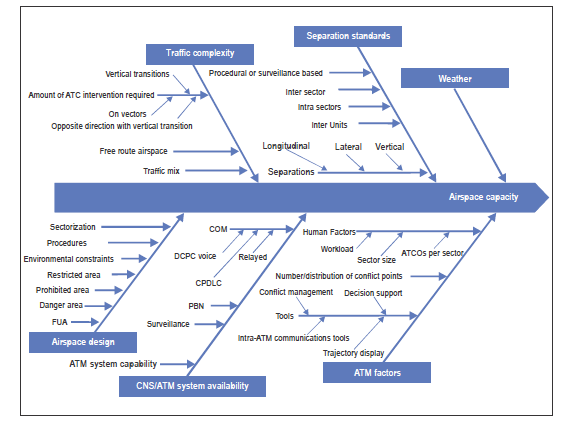
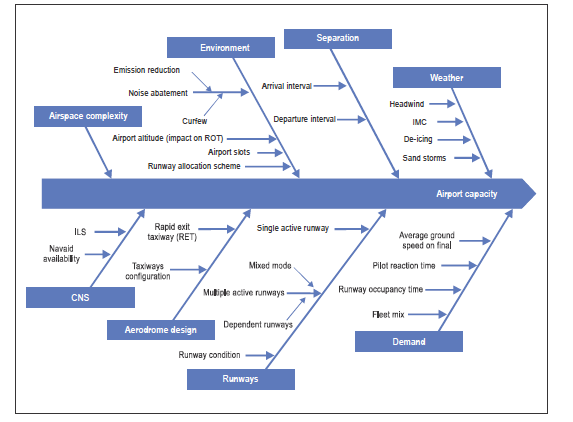
They all recognize that there are at least, some group of variables that will affect the Runway or Sector Capacity and these are shown in ICAO DOC 9971:
Capacity output
Once the variables have been qualitatively identified, it is time to transform them into qualitative values… but what is our desired output?
Skybrary speaks about three main methods to describe a sector’s capacity:
Entry counts: Capacity is expressed in maximum aircraft that are handled per time unit, usually one hour (e.g. 30acft/hour)
Frequency occupancy: Capacity is expressed in maximum number of aircraft on the frequency (e.g. 20 acft at the same time)
Controller workload: This method is based on an assessment of how much time the controller needs to perform all necessary tasks.
Which one is the best? There is no single right answer; that will depend on what one is looking for and the operational context.
Capacity Calculation
Once we know the variables and our desired output, we can perform our capacity calculation.
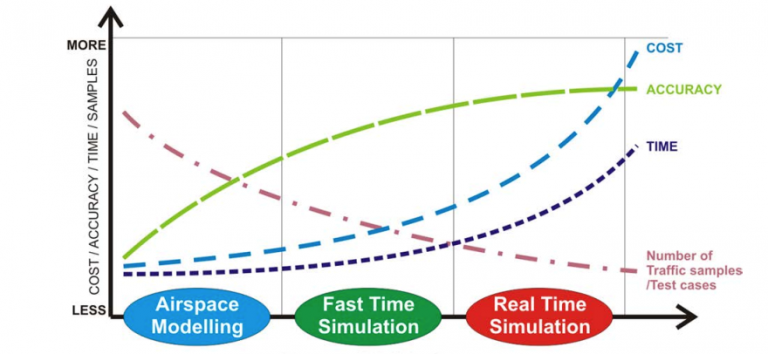
Again there are several methodologies to perform capacity calculations, where some are based on recollection of data on the operation such as sector flight times, frequency times, etc., others are based on running fast time simulations and others in using simplified methods for faster results.
An analogy could be made with the validation process for a new airspace:
Next Steps
I have calculated my capacity! What now?
Having calculated your capacity is only the first step. It is important to keep in mind the number and the variables as it is not a fixed value and it might change during the operation.
There are several actions that can be performed once capacity has been calculated, but probably the most common one is to compare it against the predicted demand and, if it is detected that demand will be greater than the capacity, take some actions to further increase the capacity or to regulate the demand.
Of course, there are many other actions and assessments that can be performed, but for sure having this value is required.
INGENAV
At INGENAV we can help you with:
Runway and ATC Sector Capacity Assessments
Runway and ATC Sector Training
Runway and ATC Capacity Consultancy
Moreover, INGENAV is certified in ISO 9001:2015 for Design and Delivery of Training in Air Navigation and Consulting in Air Navigation as well as is a Training Organization for Air Traffic Control training in accordance with EU regulation 340-2015.
Automation in air traffic control (ATC) has been on a steady rise for a very long time now. We moved from no surveillance, to primary and then to secondary surveillance. From paper writing the flight details to printable strips, to electronic strips and to label based information. From no integration between plots and flight data to a high integration and trajectory prediction. From no ATC support control tools to short-term and then medium-term conflict detection, to probing and what-if tools. And this rise of automation will continue and will accelerate.
Early generation automation provided controllers with information acquisition (e.g., secondary radar display), then came automation that provided analysis, such as the probing mentioned earlier. Higher processing capabilities as well as the use of big data will allow us to see incursions into higher-end automation in the coming years. ATC systems will start providing decision suggestions that can be implemented by the controllers. Later we will also see some actions being implemented by the system. All this will come.
However, automation will not replace air traffic controllers, at least for a considerable long while. What it will do is augment the system capability to safely handle more traffic. We talk about human-centric automation, where automation will be used to enhance the capabilities and compensate for the limitations of air traffic controllers who will remain responsible for the safety and effectiveness of a complex ATC system. This will mean that on the one hand automation will need to be implemented to actually help humans and that the total sum of work, in terms of complexity and volume should at least remains stable, and on the other, that the system will need to be redesigned to allow for this enhanced human-machine interaction.
What I am referring to when I write about system redesign is to rethink not only the machine´s new role into the system but also the human´s. What are the skills, knowledge and attitude that will be needed in a high-end automatised system? What will be expected during normal operations and then during contingency operations? And then, with regards to skills: what skills will be needed in both situations and at what level? And what skills will be needed by controllers during contingency situations that are not used anymore during normal situations? And how will we mitigate to maintain a certain skill proficiency?
Some speak about the automation paradox which says something like that the increase in automation will bring an increase in human workload. I honestly do not understand why they call it a paradox unless those who do so have a misunderstanding that the human will do nothing thanks to automation and will be phased out. If one simplistically sees the objective of automation as to phase out humans, then yes, I understand they might see this as a paradox! But the aim of automation is not (or should not be) that. The objective of automation should be to allow a system such as the air traffic management one, to cater for more capacity, whilst maintaining very high levels of safety, stability and resilience. The goal should be that the system performs better with the best team of resources possible, and that team will include humans for quite a long while.
Many adaptations will be needed to have all this possible. Contingency procedures will need to be re-written, for one, and the role of training will also need to evolve, and that is the theme of this post.
One area that needs to be considered in-depth, with the dawn of decision support and decision implementation, is skill degradation. Currently, decisions are made up by the controller, based on automation-supported information. In the future, some (or many) decisions will be proposed by the system to be implemented by the controller, and/or some decisions will be implemented by the system, and the human might be expected to take over at least as a first contingency level, should the system fail. It is already hard to do this with the current skill set, let alone with one which is degraded because unused. So, what could be done? Let us look at another situation where skills have not been used for a while and how many air navigations services provider (ANSPs) have dealt with that degradation:
During the current COVID pandemic, traffic went from an all-time high to an all-time low. After an initial shock, many ANSPs decided to implement “skill-up” programmes for their controllers. These consisted of regularly planning controllers into simulation sessions of traffic loads and complexity similar to pre-pandemic levels. This is currently mitigating somewhat to the lack of skill practice in operations due to lack of traffic.
One of the things that could and in my opinion should be done, with the dawn of decision and implementation support by the machine is to regularly plan our controllers for simulation sessions in which they would need to practice their decision-making skills. Regular practice in the simulation would somewhat mitigate the skill loss in operations.
Refresher training in the simulator should be transformed from the currently abnormal and emergency situation centred one to one in which decision making is practised with lower degrees of automated support in both routine and non-routine situations. Also, the decision-making skill maintenance training would need to be done more often than the usual once every year refresher that is mostly the case nowadays. It should be something that becomes a routine and part of the monthly rostering of positions: many operational duties mixed with some simulation, skill maintenance duties. Simulation should become more routine than once a year event.
Some might see this thought as counterintuitive (or a paradox), and expensive. However, it is not so as the benefits of automation will be such that the system will considerably gain in capacity and efficiency. Some of that will need to be retro-alimented back to those who will need to maintain their skill set to be a highly effective part of the system. It´s a bit like in soccer, or other sports, where the team is not only made up of the 11 on the pitch but also, amongst others, of the other 5 on the substitute bench during the match. These players do not train less because they are playing less. They will train just the same as their teammates, and if anything, even train more, to make for the lack of match practice! And no one I know calls that a paradox!
Airport Collaborative Decision Making course
Airport CDM covers the processes and eventual tools that permit airport partners to work together more efficiently and transparently.
This three day course emphasises the benefits to all airport partners through highlighting the importance of full and common operational situational awareness. It explains how to fully implement Airport CDM at the delegates’ respective airports and describes the local benefits, the return on investment and the gains envisaged for the overall ATM network.
Delegates will receive a detailed understanding of data sharing and situational awareness at airports between all players involved and gain an understanding of the difficulties that may be encountered, plus how to successfully secure support from colleagues.
Introduction to Air Traffic Flow Control Management (ATFCM) course
This three day course provides a good theoretical knowledge and understanding of Air Traffic Flow and Capacity Management and Network Operations, mainly focusing on the operational processes of the Aircraft Operators.
The course covers principles of flow control, flight planning, IFPS, Network operations portal, and the Network Manager’s systems and procedures.
CRM is the effective use of all available resources for flight crew personnel to assure a safe and efficient operation, reducing error, avoiding stress and increasing efficiency.
The objective of the three day CRM course is to provide candidates with the knowledge, training and skills in interpersonal areas to improve aircrew safety and efficiency.
This two day course covers the phenomenon of fatigue and its effects on safety, performance and health in ATM.
Candidates will learn to understand what causes fatigue and also look at sleep science and how it can help in developing strategies for the prevention and management of fatigue.
The course also examines the relationship between the regulations EU 373-2017 and EU 340-2015 and Fatigue.
This two day course covers understanding the causes of stress, how stress affects individuals, constructing strategies for its prevention and how to manage it. All necessary skills for both ATM Management and Operational Staff.
The course also covers the relationship between regulations EU 373-2017 and EU 340-2015 and Stress.
This three day course focuses on those facets that facilitate an increase of safety and efficiency in an operational environment via the effective use of the different components forming an operational aviation team.
The TRM course is an acceptable means of compliance with ATC Refresher Training in Human Factors.
This five day course facilitates learning through discussion, presentations and group work on improving management practices for operational supervisors, by raising awareness in the personal, team, organisational and external dimensions and domains.
The course is based upon EUROCONTROL´s Guidelines for Management Training for Operational ATM Supervisors (HRS/TSP-004-GUI-07).
This is a two day course giving candidates a comprehensive introduction to human factors in aviation, as well as showcasing the key reference documents and examining methodologies.
The course covers, the origins of human factors, a systemic approach to human factors, the human information processing model, human error, decision making, situational awareness, stress management and more.
Effective Interpersonal Communication Skills course
During this course candidates will improve their understanding of cross-cultural differences, explore different communication methods, and learn how to deliver information clearly and concisely according to the needs of an audience, particularly in an operational environment.
This course also teaches about the following types of communication: verbal and non-verbal, written, briefings, and refines presentation skills, forming communications plans, etc.
This three day course delves into how to perform a training needs analysis, covering topics such as identifying the skill/knowledge gap, who are the target audience, the difference between skills and knowledge requirements, setting training objectives, and more.
There are two Synthetic Training Device Instructor (STDI) courses in the training programme, an initial and refresher course.
Both courses cover the theoretical knowledge and practical skills for controllers who will undertake instructional duties on a simulator or a synthetic training device.
This two day course introduces the specific elements of management in a training function and includes: training strategy, human resources, facilities, communication, training portfolio, among others.
It enables participants to understand the key elements of managing training in small and large organisations and to bring the training function into the strategic core of an organisation.
This is a five day course course covering various techniques on how to deliver classroom instruction. It includes: lecturing, facilitation, presentation skills, establishing contact with students, motivation, obtaining feedback and more.
Upon completing this course, candidates will have the ability to prepare effectively for training, managing and evaluating training events, to teach students with improved skill, have practical presentation and communication skills and be able to motivate participants and engage their participation during training.
This four day course explores the training development process from the moment the syllabus and objectives have been determined, right up until the course is ready for delivery.
It includes identifying and describing the different phases of the instructional design process; converting training needs into performance objectives; identifying characteristics that influence the design and delivery of a training course, creating lesson plans, choosing training media and methods, and developing training material and assessments. It also includes how to evaluate training success.
Max began his Air Traffic Control career at the EUROCONTROL Maastricht Upper Area Control Centre (MUAC) in 1995, where he remained until 2010. During that time he occupied various positions in operations, training, and business management.
Max left EUROCONTROL to join SENASA as Head of Training in Madrid, Spain and is now Ingenav’s CEO, carrying out projects concerning air navigation Operations, safety assessments, human factors and training.
Unusual situations, emergencies and contingencies course
This three day course is custom made for the rating being trained on, i.e. Tower, Approach or En-Route and is based on practicing different scenarios using an ATC Simulator.
It explores several unusual or emergency situations and shows the commonalities between them.
The aim of the course is to present unusual and emergency situations, and to practice and refresh procedures on how to best manage them.
Introduction to Communication, Navigation and Surveillance
This two day course on Communications, Navigation and Surveillance systems in Air Traffic Management aims to give a good overview of the systems, what they are, how they interact with one another and how together they enable current and future air traffic services.
The course also discusses how these systems will likely develop in the future, including the elements and enablers that will make the system work, and the implementation strategies.
This two day course aims to give a good overview of how the air traffic management part of aviation is organised (air traffic services, airspace management, flow control, etc.)
This course provides participants with an overview of how current air traffic is managed as well as how this will probably develop in the future, including the elements and enablers that will make the system work and the strategy for its implementation.
It outlines the organisation of airspace, the time sequence for flow management and flight events, and the data flow and interactions between databases and controller working positions including the dialogues between pilots and air traffic controllers.
Rachael is a safety psychologist with more than 25 years’ experience in human factors and safety culture in the aviation and energy sectors.
After completing her PhD at Aberdeen University, in human factors incident investigation systems in the oil and gas industry, Rachael became a Human Factors Expert in air traffic management at EUROCONTROL.
She has undertaken safety culture surveys across European Air Navigation Service Providers, as well as at a regional airline in Kenya. She is currently involved in human factors assessments of new systems in ATM and is developing training on Stress and Fatigue Management as a freelance consultant.
Nicolas has over 10 years of experience in Aviation and Air Navigation Services, beginning his career as an Air Traffic Controller in Ezeiza Tower, Argentina. He later responsible for the planning department in Empresa Argentina de Navegacion Aerea (EANA) and subsequently its planning manager.
Nicolas has been involved in diverse aviation projects including airspace redesigns, new service implementations, and ATC sector and runway capacity changes.
Nicolas holds a CPL/IR and is Ingenav’s training manager and Senior ATM Consultant.
Mike is an Aviation Safety Expert with over 40 years of experience.
He is member of the International Society of Air Safety Investigators (ISASI) and of the Canadian Owners and Pilots Association and has served as a member for Civil Air Search and Rescue for more than 25 years.
Currently, Mike develops and provides safety awareness training and guidance on Implementation of Risk Management programs and Safety Management Systems, Crew Resource Management, Pilot Decision Making, Human Performance in Aircraft Maintenance, Human Factors in ATC Operations, Company Aviation Safety Officer and Human Factors in Airport Operations.
Araceli graduated in Labour Relations and has over 20 years’ experience in business management.
Prior to joining Ingenav, Araceli worked as a Human Resources Director and an Administration and Finance Director across several different sectors, in both public and private companies.
Araceli is Ingenav’s Quality, Safety and Administration Manager where her main responsibilities include ensuring the company meets its safety and quality commitments, and the effective management of all the company’s administrative processes.
Carlos started his career in 2005 as a technical engineer in computer systems, working in command and conquer international programs for several armies.
In 2008 Carlos participated in ATC programs, developing, analysing and testing functions in the SACTA system, mainly in Flight Plan Terminal.
In 2012, Carlos started working in integration and developing helicopter simulators for the Spanish army and, during 2015, he worked on the development of a secure navigation platform.
Carlos has collaborated with Ingenav as software engineer since 2016.
Anthony Seychell is an accomplished ATM safety expert with a background in both ATC operations and ATC engineering.
Previously having held a variety of posts at Malta Air Traffic Services, the most recent being as Safety Manager, Anthony joined EUROCONTROL in 2007 and was coordinator of the Programme supporting ANSPs in SMS Implementation (SASI) and he provided support for other ESP activities until his retirement in 2021.
Anthony remains active in numerous ATM initiatives.
Max began his Air Traffic Control career at the EUROCONTROL Maastricht Upper Area Control Centre (MUAC) in 1995, where he remained until 2010. During that time he occupied various positions in operations, training, and business management.
Max left EUROCONTROL to join SENASA as Head of Training in Madrid, Spain and is now Ingenav’s CEO, carrying out projects concerning air navigation Operations, safety assessments, human factors and training.
David began his career as an Electronics and Communications Engineer, migrating into the then new field of Information Technology and subsequently worked in many different IT areas including Networking, PC Support, Server and Database Administration and Project Administration.
He served as a Civilian Instructor with the Royal Air Force Reserve (Training branch) for six years, where he taught multiple aviation subjects among other things. A qualified PPL(A) and simulator pseudo-pilot who knows the PRINCE 2 and PPS project management methodologies, he is also a CELTA-certified teacher of English as a Second Language specializing in Aviation English.
David joined Ingenav in 2021 as the company’s Technology Manager and Project Admin.
Carlos started his career in 2005 as a technical engineer in computer systems, working in command and conquer international programs for several armies.
In 2008 Carlos participated in ATC programs, developing, analysing and testing functions in the SACTA system, mainly in Flight Plan Terminal.
In 2012, Carlos started working in integration and developing helicopter simulators for the Spanish army and, during 2015, he worked on the development of a secure navigation platform.
Carlos has collaborated with Ingenav as software engineer since 2016.
Anthony Seychell is an accomplished ATM safety expert with a background in both ATC operations and ATC engineering.
Previously having held a variety of posts at Malta Air Traffic Services, the most recent being as Safety Manager, Anthony joined EUROCONTROL in 2007 and was coordinator of the Programme supporting ANSPs in SMS Implementation (SASI) and he provided support for other ESP activities until his retirement in 2021.
Anthony remains active in numerous ATM initiatives.
Rachael is a safety psychologist with more than 25 years’ experience in human factors and safety culture in the aviation and energy sectors.
After completing her PhD at Aberdeen University, in human factors incident investigation systems in the oil and gas industry, Rachael became a Human Factors Expert in air traffic management at EUROCONTROL.
She has undertaken safety culture surveys across European Air Navigation Service Providers, as well as at a regional airline in Kenya. She is currently involved in human factors assessments of new systems in ATM and is developing training on Stress and Fatigue Management as a freelance consultant.
Mike is an Aviation Safety Expert with over 40 years of experience.
He is member of the International Society of Air Safety Investigators (ISASI) and of the Canadian Owners and Pilots Association and has served as a member for Civil Air Search and Rescue for more than 25 years.
Currently, Mike develops and provides safety awareness training and guidance on Implementation of Risk Management programs and Safety Management Systems, Crew Resource Management, Pilot Decision Making, Human Performance in Aircraft Maintenance, Human Factors in ATC Operations, Company Aviation Safety Officer and Human Factors in Airport Operations.
Nicolas has over 10 years of experience in Aviation and Air Navigation Services, beginning his career as an Air Traffic Controller in Ezeiza Tower, Argentina. He later responsible for the planning department in Empresa Argentina de Navegacion Aerea (EANA) and subsequently its planning manager.
Nicolas has been involved in diverse aviation projects including airspace redesigns, new service implementations, and ATC sector and runway capacity changes.
Nicolas holds a CPL/IR and is Ingenav’s training manager and Senior ATM Consultant.
Araceli graduated in Labour Relations and has over 20 years’ experience in business management.
Prior to joining Ingenav, Araceli worked as a Human Resources Director and an Administration and Finance Director across several different sectors, in both public and private companies.
Araceli is Ingenav’s Quality, Safety and Administration Manager where her main responsibilities include ensuring the company meets its safety and quality commitments, and the effective management of all the company’s administrative processes.
Max began his Air Traffic Control career at the EUROCONTROL Maastricht Upper Area Control Centre (MUAC) in 1995, where he remained until 2010. During that time he occupied various positions in operations, training, and business management.
Max left EUROCONTROL to join SENASA as Head of Training in Madrid, Spain and is now Ingenav’s CEO, carrying out projects concerning air navigation Operations, safety assessments, human factors and training.
David began his career as an Electronics and Communications Engineer, migrating into the then new field of Information Technology and subsequently worked in many different IT areas including Networking, PC Support, Server and Database Administration and Project Administration.
He served as a Civilian Instructor with the Royal Air Force Reserve (Training branch) for six years, where he taught multiple aviation subjects among other things. A qualified PPL(A) and simulator pseudo-pilot who knows the PRINCE 2 and PPS project management methodologies, he is also a CELTA-certified teacher of English as a Second Language specializing in Aviation English.
David joined Ingenav in 2021 as the company’s Technology Manager and Project Admin.