Category: Train the trainers

  • More learning tools and skills for our instructors and teachers as a basis for innovation

    Last week, I had the honor to give a presentation at Eurocontrol`s ATM Training Team (ATT). The ATT could be regarded as a network of training organisations and supervisory authorities in the sector of Air Traffic Management who meet to share information and to learn from each other and from external sources. 

    As from this December meeting onwards, a number of fixed agenda items have been put in place inside the bi-annual meetings. One of these is about innovation. Ingenav was invited to give the first presentation in this series. When asked to consider a presentation topic I thought that the right way to start is to try to set the basis right: There are many reasons a training organisation might want to innovate, and the first step in that direction should be to know why.

    Each training organisation I know in our field has an organisational structure which includes a management tier, composed of elements whch include functional (training) management and administrative management (finance, resouces/people, IT, etc.). The what I call functional management is normally composed of the teaching staff and their management. In some training organisations, mainly the bigger ones, this area also includes support to training development and delivery, both in approach and also in content. In most of the organisations I know however, this support service is either non-existant and the tasks fall on the instructors, or there is a gap in knowledge, understanding and expectation between these professional training support staff and those tasked with teaching.

    The problem mainly comes from this area, I think, in that our instructors, most of the time, are not as skilled and knowledgeable as they should be in learning theories and approaches. The reasons to this situation are in my opinion valid ones, in the sense that this personnel is recruited firstly for their subject matter expertise (ATC) it is a regulatory requirement, AND with a minimum knowledge and skill in terms of teaching. Some organisation recruit with a minimum requirement of an on-the-job trainining or synthetic training device endorsement, the training of which can be resumed to a couple of weeks of initial training mainly in practical instructional techniques and a bit of learning theory and human factors applied to training plus a minimum number of years of experience and periodic short refresher trainings that very rarely go further than refreshing the same techniques learnt in the initial course (and rarely building on them). Other organisations go a bit further and require candidates to have followed classroom instruction techniques or similar courses. Some organisations give internal improvement courses to their staff in the area of teaching and others don´t.  However in all (or at least in most as never say all) cases, none of this compares even remotely, for example, to the training a professional teacher receives.

    The result, amongst other things, is that this staff, who is the first line of contact with the students lacks the background knowledge, skill and especially confidence to innovate. We learn from experience (which in other words from mistakes we commit with previous students) and from copying models of our predecessors, who in turn were poorly trained themselves.

    So, without goining into further analysis of the issues that this situation arises, in terms of the subject of the title of this blog entry, how can we innovate if our basis – our instructors, are shaky in their knowledge and confidence on how should they best approach their tasks, adapt to new situations and propose improvements?

    Back to the ATT:

    The idea that I presented in the ATT aims, at least in part to deal with this:
    To provide our instructors with ideas and a framework on how they could see, organise and deliver, and think of improvements in training.

    For the past 7 years we have been organising workshops (at Skyguide, Eurocontrol, FABEC and DFS) aimed at instructors to see learning as a series of events that occur to students who through the use of methods managed and delivered by our instructors assimilate knowledge and become skilfull in the competences required.
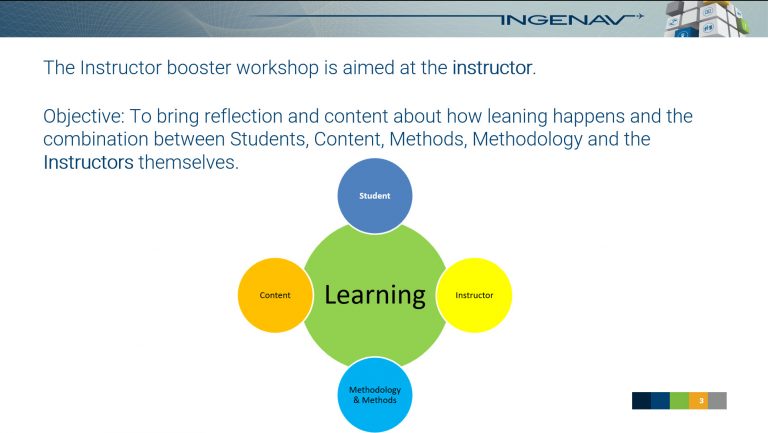
    During these workshops which also aim at motivating our instructors and to give them further confidence in their didactical choices, we reflect on the profile of the students they teach. We discuss gender gaps and current preferences and relationship their students have with items such as critical thinking, the use of technology, attention span, etc. We then consider the content and the competence areas we need to facilitate learning in and study its nature: rather theoretical or practical? Concrete or rather abstact. Is the relvenace for the students clear? Is it condensed or delivered with time? Etc.

    After this we do a good introduction to methodologies such as adult learning and the staged self directed learning model. We also look at gamification. We dig down into seeing what methods such as student centred learning or the flipped classroom have to offer. Then we look at some tools such as using videos on demand, authoring and editing tools which are accessible to non experts, and more.

    Finally we look at what is expected from us as teaching professionals: being teachers, instructors, facilitators and also coaches. We do an analysis of these needs and discuss and action plan.

    We come out revitalised, “boosted” in our profession as teachers/instructors, along with that of being subject matter experts. We have a basis to think of innovation from the roots, from those who are the mortar in ATC training.


    If you wish to receive more information about these workshops, please do contact us!
  • The 1st 100 years of ATC training and the next 10.

    A couple of months ago I was invited to write an article for the IFATCA Controller magazine about the 1st 100 years of training. Here is the text of that article:

    Looking back at the past 100 years, it is astonishing to see how fast the aviation industry developed. In doing so, a need was created to ensure order and safety in flight, and at airports. Air Traffic Control developed in order to meet the demands of safety standards of the young aviation industry.
    The pioneers of this new air traffic control discipline learned from experience. They developed best practices which were gradually turned into rules, procedures and regulations, initially at aerodromes but gradually expanding as aircraft extended their range.

    These pioneering air traffic control experts not only wrote the rules they had adopted: they also began to hand down their knowledge and skills to new generations of controllers. In doing so, they became the first instructors. They held the body of knowledge that bidding air traffic controllers needed before they could move on to practice on-the-job, under the supervision of an established controller: principles of flight, navigation, communication, air traffic procedures. As air traffic grew in volume and complexity, so did the air traffic control system, though almost always slightly lagging behind. As the system matured, so did the realisation that an air traffic controller needed particular skills. Until then, the main criterium for eligibility as a controller was intellect: one needed to have an appropriate educational background. With the realisation that particular skills were also needed, came a new challenge for training: how do we train those skills to the adequate level?

    The answer was through simulation that could expose new controllers to situations that they would possibly experience one day, but that were far from guaranteed to happen during on-the-job training. It made controller    training more efficient and neutralised the higher exigencies borne from the fact that air traffic was becoming so complex that in certain units the on-thejob training, without of the use of prior simulation was becoming very long.

    Over the years, these simulators became increasingly sophisticated. Tower simulators were initially little else than model airports with various ways of moving model aircraft around. More recently, they have benefitted of powerful 3d graphics generation and projection possibilities that can reproduce the most challenging tower situations.

    When I joined ATC in 1995, I discovered a particularly mature system in which the body of knowledge, divided into subjects (what all of us mostly know) was taught first, followed by simulation on generic situations, followed by transitional training from the generic to unit specific and finally to on-the-job training. Almost 30 years have passed since then, and ATC training continued to evolve, growing increasingly sophisticated. Apart from initial training to qualify as a controller, there was an increased need to establish requirements for maintaining the competence and to periodically refresh skills and knowledge. Development training, first for instructors, then for assessors and for other functions developed. Regulation also became with time more sophisticated, and more dominant, with minimum requirements for training to achieve competence, to maintain competence, to train others and to assess competence.

    With the continuous development of the science of human performance and growing understanding of its link to safety, training in applied human factors (notably team resources management) passed from being a best practice to (at least in Europe) a regulatory requirement. Teach and instruct has grown to include facilitate and to coach. None of these four “teaching” techniques can be singled out, as they complement each other and should be used as needed. Students are actively encouraged, most of the time not only to “just” learn but also to reach their best performance and potential. Controllers who act as instructors and assessors are better supported. Maintaining and monitoring competence in day-to-day operations have gotten a lot more focus over the past decades. Air traffic control training has definitely matured in these first 100 years!

    But there are still areas where we can improve. Unfortunately, with explicit regulation becoming very prominent, we tend to forget best practices and good intentions. Performance is measured against regulatory requirements, often ignoring common sense. In some cases, there is even a trend towards mediocrity and doing the minimum possible, rather than seeking excellence. In more extreme cases, it has created a race to the bottom, even if we do not know where that would be. Our regulations far from perfect. They dictate things from a common agreed minimum and, in many cases, there is the unfortunate assumption that compliance with a regulation is a guarantee to obtain the desired outcome. Organisations feel compelled to comply with regulatory requirements, while looking for the cheapest solutions. They are at risk of unlearning essential skills that brought us to where we are and instead. Instead, we explore the lower limits of where training can be rather than to aspire to explore the upper ones.

    So where do I think we will go in the next 10 years? The pessimist in me says that we could keep exploring the race to the bottom until we are confronted with or exposed to serious threats to our safety records. It will then take significant cost and effort to fix the system that we have dismantled. But the optimist in me says that we have always shown professionalism and that we are part of an industry that has always been concerned, at times to the limits of a healthy obsession, with excellence and safety. If we go this way, I can see us progress in three main areas:

    1. We continue in our increased understanding of performance and to advance in our teaching techniques to help student controllers and also our qualified colleagues to reach and maintain the level of competence needed.
      This will pass through the further professionalisation of our instructors, both on-the-job and especially in our schools where we will continue to improve our learning to master a broad number of techniques and skills including coaching, skills training, the understanding of the human factor, the human – automation interface and so forth.
    2. The continuous improvement of technology that needs to accompany our understanding of how performance is acquired and maintained. That we understand which are the fundamental skills of tomorrow´s controller and have the support, through for example sophisticated modules and simulators, to train them and build on them in a seamless way from the beginning through the achievement and maintenance of competency. To better blend skill
      with knowledge acquisition rather than seeing them as two distinct parts.
    3. The third is the training of how we as controllers and our students learn to reflect on our performance, how we learn how to analyse our strong and weak points periodically and frequently stop from the action – reaction duo and include the reflection and make it a threesome (a bit like the famous first de-briefing question we all teach in the OJTI course: “How do you think you did today, Max?”). We can then grow into self-directed learners of our own profession, diagnosing our needs and asking for help as we find necessary.

    In this way, I believe we can move into full maturity for the next 10 and perhaps 100 years, so that human- centricity in our sector takes its full meaning: that we are not only used because there is no other way without us but that we are the conscious part of an increasingly automated system.

  • Instructor Booster workshops – Now also online.

    A few years ago, I was contacted by an ATC academy with a request to help them with a number of objectives which included:

    • forging a stronger instructor´ team,
    • go beyond the minimum knowledge required (usually the instructor endorsement and classroom instructions techniques) and
    • to reflect on best-fit training delivery methods.

    I then set out to create a workshop with these objectives in mind.

    Now, we are fours years down the line, with eight of such workshops delivered to four European ATC schools. Five further workshops are already planned for between the end of this year and 2021.

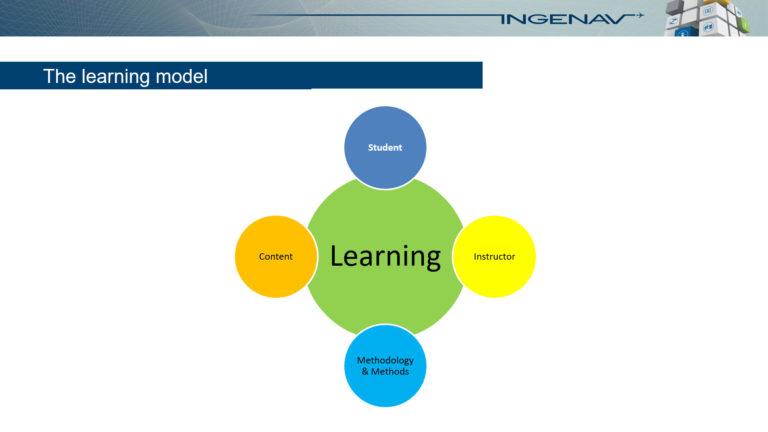
    The workshops are a mixture of facilitated sessions and presentations in which we go through a simple, but effective, model that says that to consider learning we need to consider 4 areas: Who, What, How and By Whom.

    The who is the student, who has a need to learn, the What is the subject matter – or content, the How is the methodology and methods used and the By Whom is, of course, us the instructors/teachers/coaches.

    We go through a reflective path to consider all these elements as the basic ingredients that make up a plate. One can say that there are as many learning experiences as there are plates and the trick is to dose the basic ingredients right. However, as anyone who has attempted a little bit of cooking knows, before dosing an ingredient, one needs to know what it tastes like and what effect it´s presence (or absence) and quantity will produce in the plate.

    The results help those attending, who range from instructors to training managers and those responsible for training development to reflect about the fit of the learning experience to the ingredients they have: the type of students and the subject matter. It helps them think on whether adjustments to the methodology and methods are necessary and finally to determine their own needs to be an integral part of the recipe.

    The feedback received is very positive. We step down the hamster wheel called routine (no wonder that in many languages routine (from road) and wheel are related) and start reflecting on what is working and what can be improved. We come out of the workshop with insight into our work and our needs as instructors. We also come out with concrete ideas on how and where to make adjustments.

    This year brought a new challenge: These workshops were until now held in a face to face set up with a lot of team exercises and dynamics. With restrictions in meeting and in travelling, we had to take a decision to either postpone the planned workshops, and lose good time when actually reflection and change COULD take place, or find another solution. We decided to go online. We had to consider the number of participants and also most of the exercises and the dynamics in which they are done. The first such workshop took place a week ago with very good results!

    As for me, each workshop is a learning experience. I do provide my ideas through the presentations and also challenge the status quo. I also learn a lot, from the day to day examples, from the insight that my fellow instructors provide and also come out energised ready to do more to improve the learning experience in our business!