
Category: Training

  • Diversity of perspective – safety and team resources management

    There are at least three types of truths –

    Alternative truths: (actually “alternative facts”) a term coined by a US counsellor and synonym with “fake news”,

    Objective truths: that deal with things that can be objectively measured against an agreed standard and therefore the result either is or is not – for example, 5NM separation minimum either is or is not if measured by a well-calibrated mode. And

    Subjective truths: those things that are true (or false) to us because we analyse them against what we know, how we experience what happened and against our values and believes. For example,  from where I stand it is true to me that the sun is a sphere of white/yellow colour which emits both light and heat.

    The focus of this post is on subjective truth and diversity of perspectives:

    A subjective truth, as the term entails, is true to the subject experiencing it. Someone close to the north pole, who has not had access to any scientific explanation of what the sun is, could say that the sun is a yellow circle that appears on the horizon and which emits light. Both this person and I hold an experience of what the sun is, and no one can tell us that what we experience is untrue – even though objectively the sun has other characteristics that neither I nor this person can experience and therefore describe as part of their truth.

    Now, bringing this thought to air traffic control, where our job is primarily to achieve and maintain objective truths such as minimum safety standards, I believe that sometimes we mix up what is objectively a fact and the subjective truths we derive from experiencing situations1. We forget that in the realm of subjective truths, these truths can vary to a large degree between peers and we also forget that the aim is not to debate on who is right or wrong – which makes no sense, but to sum up these truths to make up something richer.

    Put in another way, when we experience something, we all get a perspective of that event, based on our prior knowledge, our values and believes and our position relative to the event. A team is stronger to analyse a particular event because the diversity of perspective that a team has is richer than the mono-perspective of each of the individuals. This diversity of perspective then helps us to make better sense of the situation, it enables learning between the individuals and improves decision making.

    So where does Team Resources Management fit into all of this?

    The way TRM is delivered, through facilitated sessions around, for example, exercise or case studies, allows those who participate to get off the “act” – “react” loop of ATC and delve into more of introspection of the experiences which mark differences in one´s professional career. It creates, to those participating, an environment of sharing in which all perspectives are valued. The results of this are at least two-fold: First, it allows us to realise once more that our experiences lie in the realm of subjective (and not objective) truths, and that several versions do exist and all are valid. Second, that when the subject in discussion in a TRM session arrives at items very close to our operational home, it gives us the diversity of perspective that is one of the main enablers for learning and for a richer (call it augmented) experience of the professional world around us.

    Needless to say, that this richness derived from diversity of perspective will, in turn, improve the safety in our teams, as our teams are then wiser about the particular subject of discussion and from the knowledge that a team holds more pieces of the puzzle than the individual usually has.

    1 that experience can be either a direct or an indirect one.
  • Supporting ATC students during COVID pandemic – Ingenav´s experience

    At the beginning of April, we put up announcements on Linked-in and Facebook offering help with theory and or radar techniques to students who had their training interrupted because of the COVID pandemic. This help would be delivered for free as part of our initiative to help our sector in times of need.

    Surprisingly for us, only a few students contacted us for help and they needed reinforcement in practical skills training.

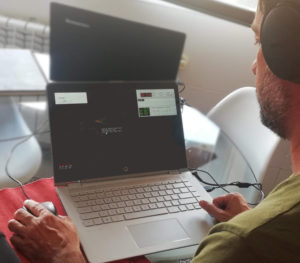
    During the months of April and May, we remotely delivered Approach and En-Route Surveillance skills training using PORT – ROSE Simulation Online ATC Simulator platform and our own exercises. Our instructors ran over 50 exercises with these students, adapted to their level of proficiency and helping them to maintain the skills they had learned already in their schools and to learn certain new ones.

    From our side, we learned better how to deliver skills training remotely. We have learned that whereas face to face contact and feedback helps in certain cases, it is not necessary 100% of the time. A blend of presential and remote/online skills training is possible. We learned that briefings and debriefings are perfectly possible in an online space and that today the technology to execute and remotely monitor a student during simulation is perfectly possible and highly performant.

    From the feedback we received at the end of these sessions, we see that the students, apart from being very appreciative of the gesture, they valued the following in particular:

    • The fact that someone else was giving a parallel and fresh viewpoint on problem-solving and radar skills, that complemented that which was thought in their school.
    • They could experiment outside of their official school program. Experimentation included: different separation techniques (vectors, vertical with rates of climb/descent, etc. ), coordination techniques, analysis of aircraft performance within the decision-making process, coordination, approaches including ILS and visual approaches.
    • Students did not find not having face-to-face interaction with the instruction a hindrance to their development.
    • The empathy and availability of the instructor during these difficult times was what they were looking for.
    • The possibility to continue practising radar skills and to avoid or at least reduce skill degradation.

    In conclusion, offering free ATC training during the COVID pandemic has been a very positive experience for us at Ingenav, and from the feedback, we received a positive experience for the students who participated. Large amounts of ATC practical training can be done remotely. The technology permits it and the methodology fits well. We are considering repeating this at a later stage!

  • A big thank you to our pool of instructors – we´ll be back!

    With this post, we at Ingenav wish to thank our closely knitted pool of instructors who have helped us in the past years to deliver high-quality training services to our clients, with a very high rate of repeat business.

    Until early March, and the COVID-19 outbreak in Europe, our network of active instructors originated from 7 different European countries. Together, we were regularly delivering services to clients in 5 countries.

    The dedication, experience and qualifications of our instructors are high, and so is the cross-fertilization that was taking place between our pool, all learning from what the other had to offer.

    Thank you to all those concerned for your hard work. This tough containment period is hopefully almost over, the time to be back in action is drawing nearer!

    We´ll be back!